By Nicholas J. Golding and Dylan J. Murphy
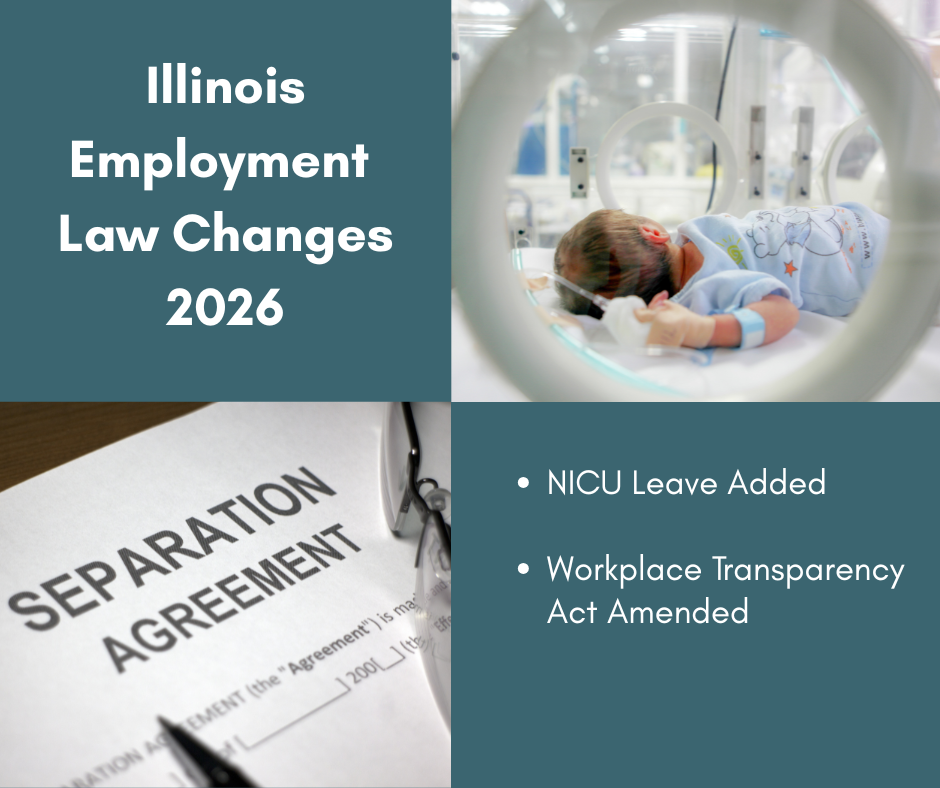
Illinois has recently seen two major changes to the employment law scene, including the creation of the Family Neonatal Intensive Care Leave Act and the amendment of the Workplace Transparency Act.
The New Neonatal Intensive Care Leave Act
Effective June 1, 2026, the Family Neonatal Intensive Care Leave Act (NICLA) provides additional leave to employees dealing with a child admitted in a specialized care unit for premature, critically ill infants commonly referred to as the “NICU.”
An employee is entitled to up to ten (10) days of unpaid leave if their employer has between 16 to 50 employees, and up to 20 days of unpaid leave if their employer has 51 or more employees. NICLA leave is in addition to any available leave taken under the Family and Medical Leave Act (FMLA). Like FMLA, employees may take leave on a continuous or intermittent basis. Unlike FMLA, NICLA leave is available to employees regardless of their length of service or part-time or full-time status.
Employers cannot require employees to use accrued paid time off prior to using NICLA leave, although employees may elect to do so. Employers may also require that NICLA leave be taken in minimum increments of no less than two hours in duration. Employers are required to reinstate the employee to their position or one substantially equivalent when the employee returns from NICLA leave. Otherwise, an employee may file a complaint with the Department of Labor or their own private civil action in circuit court within sixty (60) days of the last event constituting and alleged violation.
New Amendments to the Workplace Transparency Act
Illinois also amended the Workplace Transparency Act, which affects employment, separation, and settlement agreements with Illinois employees, applicants, contractors, and consultants. Effective January 1, 2026, these amendments broaden the definition of “unlawful employment practice,” includes protections for “concerted activity,” prohibit certain unilateral agreement terms, narrows what is required for confidentiality in separation and settlement agreements, and expands remedies available to employees.
Employment Agreements
Of particular note, these amendments will likely result in necessary amendments to employment and separation agreements going forward. Beginning January 1, 2026, new and amended employment agreements cannot contain unilateral terms that: (1) shorten an applicable statute of limitations, (2) apply non-Illinois law to an Illinois employee’s claim, (3) require a non-Illinois venue for an Illinois employee’s claim, or (4) state that confidentiality is the employee’s preference. Such terms are void to the extent they deprive employees of substantive or procedural rights or remedies concerning unlawful employment practices.
However, provisions that would be impermissible as unilateral conditions may still be included if they are mutual, which is demonstrated by containing written provisions expressly acknowledging the individual’s rights to report unlawful employment practices and criminal conduct, participate in proceedings related to unlawful employment practices, make truthful statements required by law, seek confidential legal advice, and engage in concerted activity to address workplace issues. The amendments broaden these acknowledgments beyond prior law.
Settlement Agreements
Confidentiality provisions must be supported by separate, bargained-for consideration that is distinct from consideration for a release of claims, and we recommend this be specifically stated in the agreement. Employers may not unilaterally state that confidentiality reflects the employee’s preference, and confidentiality provisions cannot restrict future or prospective concerted activity related to workplace conditions.
Employees who may bring claims under the Workplace Transparency Act have more remedies available to them. In addition to reasonable attorneys’ fees and costs, individuals may recover consequential damages for establishing a violation of the Act or for successfully defending against an employer’s claim for breach of a confidentiality obligation.
For more information about either of these new changes to Illinois law, please contact Mark A. McAnulty, Nicholas J. Golding, Dylan J. Murphy, or any member of the KDDK Labor and Employment group.