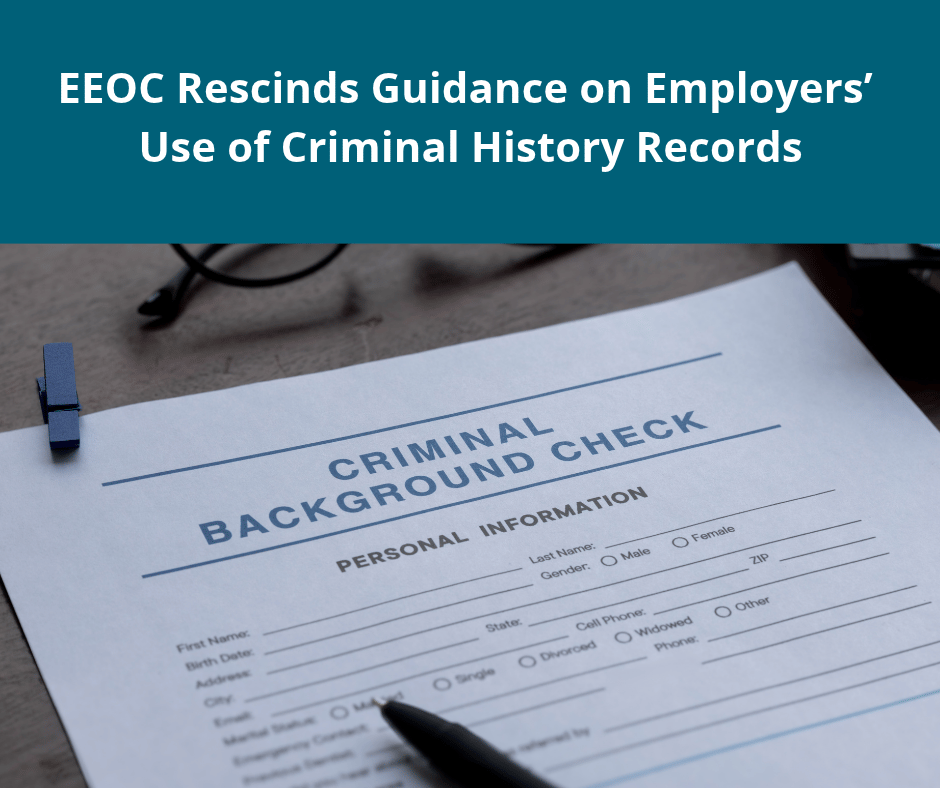
The U.S. Equal Employment Opportunity Commission (EEOC) has voted to rescind its 2012 Enforcement Guidance on the Consideration of Arrest and Conviction Records in Employment Decisions under Title VII of the Civil Rights Act of 1964. The rescission, announced on October 29, 2026, is effective immediately and represents a significant change in the EEOC’s approach to employer use of criminal background information in hiring and other employment decisions.
The 2012 Guidance
The EEOC issued its 2012 guidance to explain how an employer’s use of arrest and conviction records could violate Title VII. The guidance primarily addressed two theories of discrimination: disparate treatment and disparate impact.
Under a disparate treatment theory, an employer may violate Title VII by treating applicants or employees with similar criminal histories differently based on a protected characteristic, such as race or national origin. Under a disparate impact theory, an employer may violate Title VII by maintaining a facially neutral policy that disproportionately impacts individuals in a protected group, even without discriminatory intent.
For example, an employer’s policy of automatically excluding applicants with certain criminal convictions could create a disparate impact if the policy disproportionately excludes individuals of a particular race and is not job related and consistent with business necessity.
To evaluate whether a criminal-history exclusion was job related and consistent with business necessity, the EEOC identified three factors:
- The nature and gravity of the offense or conduct;
- The time that has passed since the offense, conduct, or completion of the sentence; and
- The nature of the job held or sought.
What Employers Should Know
The EEOC’s decision to rescind the guidance does not eliminate potential liability under Title VII. Disparate treatment and disparate impact remain recognized theories of employment discrimination.
Accordingly, employers may still face Title VII claims based on criminal-background-screening policies that disproportionately impact protected groups or are applied inconsistently. The removal of the EEOC’s 2012 enforcement guidance opens the door to the potential for more flexible interpretations when employers’ policies are scrutinized.
The EEOC also indicated that it does not intend to prioritize disparate impact investigations and litigation. That said, private plaintiffs may continue to pursue disparate impact claims.
Employers should continue reviewing their criminal-background-screening policies to ensure that exclusions are related to the positions being filled and consistent with business necessity but no longer need to meet the EEOC’s prior, strict guidance. Employers also should consider they may also have obligations under the Fair Credit Reporting Act (FCRA) and applicable state and local fair-chance, ban-the-box, and criminal-record laws.
For more information about the EEOC’s rescission or assistance reviewing criminal-background-screening policies, please contact Jackson T. Treadway or another member of the KDDK Labor and Employment Practice Group.